Learn to Protect Missions.
Build Systems That Protect Spacecraft.
A long-term education, engineering and startup pathway focused on Autonomous Spacecraft Health Management and Safe Recovery.
Illustrative simulation, not live spacecraft telemetry.
Can a spacecraft understand its own health and recover safely?
Autonomous Spacecraft Health Management is the capability to observe spacecraft telemetry, detect and isolate faults, predict mission impact, and recommend or execute verified recovery actions within bounded safety limits.
Future long-duration, autonomous, crewed, lunar and deep-space missions cannot depend on continuous ground intervention. A spacecraft must be able to observe its telemetry, detect anomalies, and isolate likely faults through Fault Detection, Isolation and Recovery (FDIR), predict mission impact, and recommend—or within verified limits execute—a safe recovery.
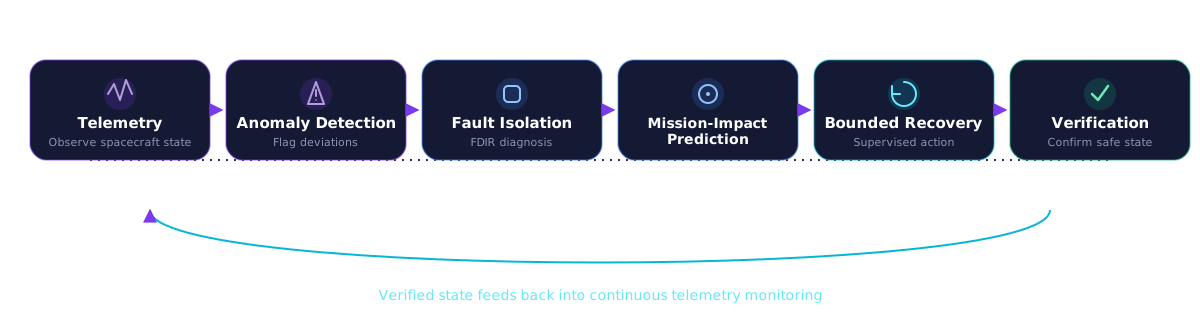
Generative AI must not directly control a safety-critical spacecraft loop. Autonomy is introduced gradually, under human supervision, and always within verified, bounded limits.
Building capability for the missions of 2035, 2040 and beyond
This research direction is aligned with publicly stated Indian ambitions, including long-duration missions, autonomous rendezvous and docking, the Bharatiya Antariksha Station goal for 2035, and an indigenous crewed lunar landing goal for 2040.
Prepared by the EV Society technical team. Last reviewed: 14 August 2026.
One mission. A lifelong pathway.
This is a Mission Pathway, not a certification roadmap — each stage builds on the last.
Ages 14–18
- Spacecraft systems
- Sensors and telemetry
- Faults, redundancy and safe mode
- Mission-health challenge
Higher Education
- Simulator and telemetry engineering
- Digital twins
- Fault detection, isolation and recovery
- Hardware-in-the-loop validation
Applied Teams
- Verified algorithms
- Fault libraries and datasets
- Papers and patent candidates
- Academic and industry validation
Young Founders
- Customer discovery
- Validated prototype
- Responsible incubation
- Space products and services
How does a spacecraft know whether it is healthy?
Space Health Explorers is a planned programme for students aged 14–18 exploring spacecraft health from first principles.
One multidisciplinary mission team
Engineering students work together as one mission team rather than on unrelated projects.
Autonomous Spacecraft Health Management System
Hands-on mission-health labs
Isolated, authorised simulations — not yet built. Express interest to help shape them.
Telemetry & Mission Operations Simulator
Practice reading and reacting to simulated spacecraft telemetry streams.
Spacecraft Power Fault Lab
Explore electrical power system faults and safe-mode responses.
Attitude Sensor Fault Lab
Investigate attitude-control sensor faults and reconfiguration.
Communications Degradation Lab
Model link degradation and communication-delay scenarios.
Fault Injection & Diagnosis Lab
Inject faults into a simulated bus and practice diagnosis.
Digital Twin Calibration Lab
Calibrate a spacecraft digital twin against simulated telemetry.
Safe Recovery Verification Lab
Verify bounded, supervised recovery actions before they run.
Learn by building mission-ready thinking
Explore guided simulation projects that turn spacecraft concepts into testable models, telemetry and engineering evidence.
Space Applications
Discover how satellites and space data improve everyday life—from weather and mobility to agriculture, connectivity, disaster response and infrastructure.
Explore Space ApplicationsEducational reference · No aerospace background needed.
Satellite Engineering
From First Principles to Spacecraft Systems Architect
A systems-level architecture and engineering leadership program covering mission design, spacecraft subsystems, digital twins, verification, operations, risk, cost and technical decision-making.
Explore Satellite EngineeringArchitecture & Leadership Track · Systems Leads · CTO · Chief Architect
Model Rocketry
Learn aerospace engineering from first principles—mission design, aerodynamics, stability, structures, propulsion, avionics, recovery and flight analysis.
Explore Model RocketryEducational aerospace learning · Beginner to advanced.
CubeTwin
A Digital-Twin Simulation Platform for CubeSat Energy, Mission and Reliability Analysis
Model orbit sunlight, solar generation, battery state of charge, mission loads, faults and safe-mode decisions through an interactive beginner-friendly laboratory.
Explore CubeTwinEducational R&D prototype · Simulated data · Not flight software.
Space Station
Explore how orbital research stations are designed, powered, controlled and operated—from life support and microgravity laboratories to docking, robotics and future lunar stations.
Explore Space StationEducational models · Sourced programme facts · Not mission design data.
Next-Generation Rocket Engine Digital Twin
Explore a reusable liquid rocket engine reference architecture—propellant feed, turbomachinery, combustion, regenerative cooling, control, simulated testing and engine health monitoring.
Explore Rocket Engine Digital TwinEducational demonstrator · Reference and simulated data · Not a real engine.
Disciplined research directions
Every theme below is Proposed or a Research Direction — none are claimed as active projects, papers, or repositories yet.
Explainable spacecraft anomaly detection
Multi-sensor fault isolation
Remaining useful life and degradation prediction
Mission-impact assessment
Safe-mode recommendation
Redundancy and reconfiguration
Cyber-physical anomaly discrimination
Verification of bounded autonomous recovery
Goals, not completed milestones
Every milestone below is a goal the team is working toward, phrased honestly as forward-looking.
Reference CubeSat, telemetry simulator, fault scenarios, first education and internship pilots.
Subsystem models, fault detection, explainable diagnosis, initial research outputs.
Degradation prediction, supervised recovery, hardware-in-the-loop testbed.
Academic/industry design partner and flight-representative pilot.
Independently verified prototype and startup-ready technology components.
A neutral platform for people who want to build responsibly
How programmes will be funded
Availability, selection, fees, sponsorship and stipend conditions will be published for each programme.
Common Questions
One mission: Autonomous Spacecraft Health Management and Safe Recovery — helping future spacecraft observe their own telemetry, detect anomalies, and recover safely with bounded, supervised autonomy.
No. This is an independent EV Society initiative. References to national space goals are provided for educational context and do not imply endorsement, affiliation or partnership with ISRO, IN-SPACe, NSIL or the Department of Space.
School students (ages 14–18), engineering students, faculty and researchers, retired scientists and mentors, space startups and industry, government and institutional stakeholders, CSR and scholarship partners, and young founders.
Planned learning areas include spacecraft subsystems, telemetry and sensors, safe mode and redundancy, mission communication delays, basic anomaly reasoning, a CanSat or simulated mission-health activity, and engineering ethics and safety.
Paid training and internships are distinct. Internships are merit-based and governed by the published terms of each cohort; sponsored or stipended opportunities will be identified explicitly when available.
No. Student, academic, EV Society, iTelematics and startup intellectual-property rights are governed through transparent written agreements. Participation does not automatically transfer a participant's IP to iTelematics.
No. The labs, digital twin, and research platform described here are Planned or Research Direction items, not operational products. Status is labelled honestly on each section.
Use the Express Interest links on this page, which open our Expression of Interest form. Submitting the form records your interest only — it does not confirm selection, admission, internship, stipend, funding, partnership or participation. For anything else, use the Partner With Us or Contact Us links, which route to our existing contact channel.
Not positioned as free. Programmes may be participant-funded, institution-funded, CSR-sponsored, scholarship-supported, grant-funded, or industry-sponsored. Availability, selection, fees, sponsorship and stipend conditions will be published for each programme.
Commercial products and services, where applicable, are handled separately by iTelematics Software Private Limited under explicit agreements — not by EV Society, which focuses on the public-interest education, research and pre-incubation mission.
Ecosystem and Responsibilities
Space is an EV Society education and research initiative hosted on EV.ENGINEER. UFlight focuses on health and usage monitoring technologies for aerospace and autonomous platforms. Commercial engineering products and services, where applicable, are handled separately by iTelematics Software Private Limited under explicit agreements.